Everything we’re asked about visits, fees, health funds and treatment — collected from across the practice and answered in plain language. Can’t find yours? Call 02 4933 4667.
First appointments, nerves, kids, parking and who you’ll see.
If you feel anxious, tell us. We'll take things at your pace, explain each step, and use gentle techniques and comfort options such as in-chair entertainment to help you relax.
General and preventative care, cosmetic work, restorative dentistry including crowns and dentures, dental implants, orthodontics and children’s dentistry — plus emergency appointments. If something falls outside what we do well, we’ll refer you rather than attempt it.
Yes, and we like to. Zoe, our oral health therapist, looks after patients under 18, and eligible children can be bulk billed through the Child Dental Benefits Schedule.
Yes. New patients can book online any time, and the first visit is no-gap with a participating health fund rebating $199 or more, or a flat $199 without cover. A $50 booking deposit applies and comes off the visit.
Allow about an hour. That gives us time to listen properly, examine thoroughly, take any X-rays, do your scale and clean, and talk through the plan without rushing you.
Your health fund card if you have one, your Medicare card (for CDBS-eligible children), a list of current medications, and your completed medical history form. If you have recent X-rays from another practice, bring those too — it may save repeating them.
Not here. There is nothing we haven’t seen, and no judgement waiting for you. Most people who’ve stayed away for years tell us the hardest part was the phone call.
For new patients it’s no-gap where your health fund rebates $199 or more, or a flat $199 without cover — including exam, treatment plan, X-rays, scale and clean, and fluoride. A $50 booking deposit applies and comes off the visit. Full terms on our offers page.
Not necessarily — walk-ins are welcome and we keep time aside for emergencies. Booking ahead means less waiting, and you can do it online at any hour.
We aim to respond within one business day. If it’s urgent or clinical, please ring instead of using the form.
135 Lawes Street, East Maitland — beside Australia Post, with the Lila & Allan hair salon next door. There’s a bus stop directly opposite and parking at the rear.
Yes — on-street parking on Lawes Street, council parking near Your Discount Chemist, and parking at the rear of the practice.
Yes. There’s an entrance ramp, easy access throughout, and an accessible toilet. The entry is pram-friendly too.
Of course. There’s a play area in the waiting room, and our team are used to keeping an eye on little ones while a parent is in the chair.
Yes — just say so when you book. If they’re away or fully booked we’ll tell you honestly rather than quietly putting you with someone else.
Dr Nish and Dr Nav are general dentists, not registered specialists. Dr Nav holds a Fellowship of the Royal Australasian College of Dental Surgeons, a postgraduate qualification in managing complex cases. Where a case needs a registered specialist, we refer.
Usually Zoe, our oral health therapist, who treats patients under 18 for check-ups, cleans, fillings, sealants and baby-tooth extractions. If something needs a dentist, one is a few steps away.
Yes — they show different things. The intraoral camera photographs surfaces you can see; X-rays show what’s between and beneath teeth, and inside bone. We take the minimum needed to diagnose properly.
Instruments are cleaned and sterilised in a dedicated room, then vacuum-packed and kept sealed until opened in front of you. Our protocols meet or exceed ADA and Australian government standards and are checked daily.
With a check-up. We examine, take any X-rays we need, show you what we find on screen and give you options with prices. You leave knowing where you stand, whether or not you book anything further.
Yes — interest-free plans through Humm and DentiCare, and for some essential treatment the ATO’s Compassionate Release of Super may apply. Lending criteria, fees and terms and conditions apply.
Call us on 02 4933 4667 and describe it — plain words are fine. A short conversation is usually enough for us to know how soon you should be seen and by whom.
No. You can book directly with us for anything on this page, online or by phone. If something ever needs a specialist, we’ll refer you and explain why.
Severe or ongoing pain, a knocked-out or broken tooth, uncontrolled bleeding or facial swelling all count — go to our emergency page or just call. When in doubt, ring; we’d rather tell you it can wait than have you wait when it can’t.
What things cost, how funds and CDBS work, and how you can pay.
Your first visit covers a comprehensive examination, personalised treatment plan, X-rays, a scale and clean, and a fluoride treatment. We'll waive the gap where your fund rebates at least $199, or it's a flat $199 without cover. For new patients only; a $50 booking deposit applies and comes off the cost of your visit.
Yes — payment is due on the day of treatment. With HICAPS we claim from your health fund on the spot, so you only pay any gap. For larger treatment plans, Humm and DentiCare let you spread the cost interest-free (lending criteria, fees and T&Cs apply).
All of them. We have HICAPS for on-the-spot claiming with funds including HCF, Bupa, Medibank, nib, CBHS, Teachers Health, Defence Health, Australian Unity and GMHBA. Your rebate depends on your policy — bring your card and we’ll check it before treatment.
Children aged 0–17 who meet Services Australia’s criteria get up to $1,158 of basic dental services over two consecutive calendar years, and we bulk bill it. Check eligibility on the Services Australia website or ask reception to help you check.
For essential treatment, the ATO’s Compassionate Release of Super can apply — implants, dentures, surgery, orthodontics, root canal and crowns among them. SuperCare facilitates applications for our patients and charges nothing unless approved. It’s a formal ATO process, so allow time.
One offer per visit — the seniors discount can’t stack on the new-patient offer, and CDBS is a Medicare benefit rather than a practice offer. If two could apply, we’ll use whichever leaves you better off.
It holds your appointment and comes straight off the cost of your visit — you don’t pay it twice. If you need to move your appointment, give us a ring and we’ll carry it over.
No — and we’ll tell you honestly. Whitening works on natural tooth surfaces and not on crowns, veneers or fillings, and some causes of discolouration need a different approach. That’s why every whitening offer starts with a suitability assessment. Results vary from person to person.
Check-ups, cleans, gum care, extractions, wisdom teeth and kids’ dentistry.
No. Ultrasonic scalers and polishing remove calculus and stain from the tooth surface — they don’t remove healthy enamel. Sensitivity for a day or two afterwards is common, especially where gums have receded, and settles.
For covered basic services, yes — we bulk bill it, so eligible children pay nothing out of pocket up to the cap. It doesn’t cover orthodontics or cosmetic work. Eligibility is set by Services Australia and we can help you check it.
No. We take them when there’s a clinical reason — checking between teeth, under existing fillings, or around roots — not as a routine at every visit. Digital sensors keep the dose low.
Often, yes, and it saves you trips. It depends on how long you can comfortably sit, whether the areas need separate anaesthetic, and what your day looks like afterwards. We’ll plan it with you.
You’ll be in good company, and there’s no lecture. We’ll examine, tell you honestly where things stand, and build a plan in a sensible order — usually comfort and infection first, appearance later.
Allow about 30 to 40 minutes for an examination, or around an hour if you’re a new patient having a clean as well. We’d rather take the time than rush and miss something.
Six months suits most people. Low-risk patients with stable gums may stretch to twelve; anyone with gum disease, high decay risk or a dry mouth benefits from three or four monthly. We’ll recommend an interval and explain why.
Yes, as part of every examination — tongue, floor of mouth, cheeks, palate and throat. It takes under a minute and it is one of the more important minutes of the appointment.
Absolutely. Book an examination, tell us when you arrive, and we’ll go at your pace — including stopping at just a look and a conversation if that’s where you want to leave it that day.
For most people it’s a strange sensation rather than a painful one — vibration, water and a bit of scraping. If your gums are inflamed or roots are exposed it can be tender, and we can numb the area. Tell us and we’ll adjust.
It removes surface staining from coffee, tea, wine and smoking, so teeth usually look brighter and cleaner. It doesn’t change the underlying colour of the tooth — that’s what whitening does.
Six months suits most people. If you build tartar quickly, smoke, or have a history of gum disease, three or four monthly is often better for a while. We’ll recommend an interval based on what we actually see.
Something between the teeth is necessary — brushing only reaches about 60% of the surfaces. Whether that’s floss, interdental brushes or a water flosser depends on the size of your gaps. Zoe will work out which suits your mouth.
Gingivitis is — the early stage, where gums bleed but no bone has been lost, resolves fully with treatment and good daily cleaning. Periodontitis, where bone has gone, can be stabilised and controlled but not reversed. That difference is exactly why we push early treatment.
It’s done under local anaesthetic, so the appointment itself shouldn’t hurt. Afterwards expect tenderness and cold sensitivity for a few days as the gums heal and tighten.
Bacteria repopulate deep pockets in roughly 12 weeks. Three-monthly maintenance interrupts that cycle. It’s the difference between keeping your teeth and slowly losing them, and it’s the part people most often let slide.
There are well-documented associations between periodontal disease and diabetes, cardiovascular disease and adverse pregnancy outcomes. The relationships are complex and still being studied, but treating gum inflammation is sensible for reasons beyond your mouth.
By their first birthday or when the first tooth appears. That first visit is mostly about familiarity — a look, a count, a sticker — and it makes every visit after it easier.
Often yes. A decaying baby tooth can become painful, infect the adult tooth developing beneath it, and if it’s lost too early the neighbouring teeth drift into the space. That said, we do weigh how close the tooth is to falling out naturally.
Then we don’t force it. We’ll try again, keep the visit short and positive, and build up over a few appointments. Almost every child gets there — the ones who don’t are usually the ones who were pushed too hard, too early.
An assessment around seven is worthwhile, not because treatment usually starts then, but because a growing jaw gives options that disappear later. We’ll tell you honestly if there’s nothing to do yet.
A boil-and-bite guard is loose by design, so it moves, it’s bulky to breathe and talk through, and it absorbs less impact. As a night splint the problem is worse — an ill-fitting one can shift your bite or aggravate the jaw joint. A custom appliance is made to your teeth and adjusted in your mouth.
An adult sports guard typically lasts one to three seasons depending on how hard it’s used. Children need replacing far more often as their teeth change — often every season. Splints usually last several years but wear faster in heavy grinders.
No, and anyone promising that is overselling. It protects your teeth from the forces you generate, so the wear happens to the acrylic instead of your enamel. Reducing stress, caffeine and alcohol, and sorting out sleep, is what reduces the grinding itself.
Yes, and they absolutely should — a knock with fixed braces can do serious soft tissue damage. The guard is made to accommodate the brackets and will need remaking as teeth move.
Usually less than the conventional alternative. Many procedures are done with just topical or local anaesthetic, and afterwards is typically mild soreness rather than real pain. If you’re anxious, say so — we’ll numb generously.
You’ll see the change immediately, but gums keep settling for two to four weeks and the final contour appears over that time. For cosmetic cases we take photographs to compare properly.
Healthy reshaped gum generally stays where it’s put. Regrowth happens most often where the underlying cause is still active — certain medications, ongoing inflammation, or plaque around the area.
Frenectomy in children is one of the more common uses, and the laser makes it quicker and less distressing than the traditional approach. We assess each child individually.
The extraction itself shouldn’t — local anaesthetic handles that, and we test the area before starting. You’ll feel firm pressure, which is normal. Afterwards expect soreness for a few days, usually manageable with over-the-counter pain relief.
Most of the discomfort settles within three to five days. The gum surface closes over in a couple of weeks, while the bone underneath continues remodelling for several months.
After a simple extraction, most people do. After a surgical one, take the rest of the day. Avoid heavy lifting and strenuous exercise for 24 to 48 hours either way.
Depends on which tooth and what surrounds it — an implant, a bridge, a partial denture, or occasionally nothing. It’s worth deciding before the extraction, since some options are easier to plan while the tooth is still there.
No, and the idea that they do is outdated. If they’ve come through straight, you can clean them, and they’re causing no problems, leave them. We remove them when there’s a reason.
Most cases are done here under local anaesthetic, awake but numb. For complex impactions or very anxious patients, referral for sedation or general anaesthetic is an option we’ll discuss.
Two to three days for most people, ideally over a weekend. Avoid strenuous exercise for about a week, since raising your blood pressure can restart bleeding.
It’s when the blood clot is lost from the socket, leaving bone exposed — intensely painful, usually starting three to five days after. Avoid it by not smoking, not using straws, and not rinsing vigorously for the first 24 hours. If it happens, come in; we can dress the socket and it settles quickly.
Not for every case. For lower wisdom teeth where a standard X-ray suggests the roots are near the nerve, it changes how we plan and sometimes whether we operate at all. That’s worth the scan.
Whitening, veneers and smile makeovers.
It works on natural tooth surfaces and not on crowns, veneers or fillings, which stay the colour they were made. Some causes of discolouration respond much better than others, which is why every whitening starts with an assessment. Results vary from person to person.
With good care, porcelain veneers commonly last ten years or more and composite bonding rather less. Whitening fades gradually and is usually topped up. Grinding, biting nails or opening things with your teeth shortens all of it.
For larger cases, yes — we plan digitally from photographs and can trial the proposed shape in your mouth before committing to porcelain. It’s the surest way to know the result suits your face, not just your teeth.
Whitening can cause temporary sensitivity for a day or so. Veneer preparation is done under local anaesthetic, and afterwards is usually mild. We’ll talk through comfort options if you’re anxious.
Most people lift several shades, but the honest answer is that it depends on your starting colour and the cause of the discolouration. Age-related yellowing responds well. Grey tones and tetracycline staining respond poorly. We’ll give you a realistic expectation at the assessment, and results vary from person to person.
In-chair is faster and supervised throughout, so it suits an event or anyone impatient. Take-home trays give a more gradual result that’s often gentler on sensitivity, and you keep the trays for cheap top-ups later. Many people do in-chair first and maintain with trays.
Professionally supervised whitening at appropriate concentrations doesn’t damage enamel. Sensitivity during treatment is common and temporary. The real risks come from unsupervised products, ill-fitting trays and overuse.
Typically one to three years, though it varies enormously with diet and smoking. Occasional top-ups with your take-home trays keep it going with much less effort than starting from scratch.
You can, but they won’t change colour, so they may need replacing afterwards to match your new shade. That cost should be part of your decision, and we’ll price it up front.
It depends on how wide your smile shows. Some people need two, most who want a noticeable change have six to eight across the front, and full upper and lower cases exist. We plan from photographs of your actual smile rather than a formula.
Traditional veneers permanently remove some enamel, and that tooth will always need covering afterwards. It isn’t damage exactly, but it is a lifelong commitment and you deserve to hear it plainly before you agree. Minimal-prep veneers and composite bonding are more conservative alternatives.
Only if they’re designed to. Good veneers vary slightly in shape and translucency, follow the curve of your lip and match your face and age. We’ll talk you out of uniform, blinding white if you ask for it.
Small chips can sometimes be polished or repaired with composite. Larger damage usually means remaking that veneer. Bring it in rather than living with it — a rough edge irritates the tongue and can trap plaque.
Yes, but a night splint becomes mandatory rather than advisable. Grinding is the single biggest cause of veneer failure. If you won’t wear a splint, we’d rather discuss alternatives.
From a few weeks for whitening and bonding, to eighteen months or more if orthodontics is part of the plan. We’ll give you a realistic timeline at the planning stage, including the waiting periods between phases.
Yes, and you should. We design digitally from photographs and can trial the proposed shape in your mouth. It’s the surest way to avoid disappointment, and it’s reversible.
That’s the aim, and it’s mostly about restraint — appropriate proportions, slight variation between teeth, a shade that suits your age and complexion. If you ask for something we think will look artificial, we’ll tell you.
No. Many people stage it over a couple of years, which spreads the cost and lets health fund limits reset. We’ll sequence it so each phase is a sensible stopping point.
Fillings, crowns, bridges, dentures, implants and root canal treatment.
Typically five to ten years, sometimes considerably longer for small ones. Lifespan depends on size, position, whether you grind, and how well the area is kept clean. No filling is permanent.
Not just because they’re amalgam. If one is sound, replacing it removes healthy tooth for no clinical gain. If it’s cracked, leaking, decayed underneath, or you dislike the appearance and understand the trade-off, that’s a fair reason.
The tooth has been irritated by the procedure, and deeper cavities sit closer to the nerve. Sensitivity to cold for a week or two is normal. If it’s getting worse rather than better, or hurts when you bite, ring us — it may simply be a high spot.
We shade-match to your surrounding teeth and it’s usually indistinguishable. Two things to know: the match is to your teeth as they are now, so later whitening will leave the filling behind; and composite picks up stain over years while enamel doesn’t, so a perfect match can drift.
The reputation comes from decades ago. With modern anaesthetic and instruments, most people find the appointment much like having a large filling — long, but not painful. The severe pain people associate with it is usually the infection beforehand, which the treatment relieves.
One or two for most teeth. Straightforward cases can be completed in a single longer visit; teeth with active infection often do better with a medicated dressing and a second appointment a week or two later.
On back teeth, almost always. A root-treated molar without a crown has a significantly higher risk of splitting, and a split tooth usually has to come out — losing the tooth you just paid to save. Front teeth can sometimes be restored more conservatively.
That’s a legitimate choice, and cheaper today. Weigh it against the cost of replacing the tooth — an implant or bridge typically costs more than root canal treatment and a crown combined. We’ll give you both figures.
It hinges on how much sound tooth and bone remain and whether the root is healthy. A tooth worth saving is usually worth saving, since replacing it costs more than crowning it. We’ll show you the X-ray and give you both paths with prices.
Ten to fifteen years is a fair expectation, and many last considerably longer. Grinding, decay at the margin and gum recession are what shorten them.
Neither is universally better. A bridge is faster and often cheaper, but requires cutting down two teeth. An implant preserves the neighbours and lasts longer, but costs more and takes months. If the adjacent teeth already need crowns, a bridge starts to make a lot of sense.
Keep it, don’t attempt to glue it, and ring us. Often it can be re-cemented. In the meantime the exposed tooth will be sensitive and is weaker than it feels, so chew on the other side.
For many cases, yes — our CEREC system scans, designs and mills the crown on site so it’s fitted at the same appointment. It isn’t suitable for every case, and we’ll tell you if yours needs a laboratory.
For most cases, yes — the ceramic is strong, the fit is excellent and the digital scan is more accurate than putty. Where a lab still wins is complex front-tooth aesthetics and multi-unit bridges, and we’ll tell you when that applies to you.
Usually around two hours from start to finish, including the milling time. You can bring something to read, watch the ceiling screen, or step out for a coffee while the crown mills.
No — it’s the same preparation under the same local anaesthetic. If anything it’s easier, because there’s no putty impression and no second round of numbing two weeks later.
We check fit, contacts and bite before bonding anything, and because the design is on screen we can adjust and re-mill on the spot if needed. That’s a genuine advantage over sending work away.
Placement is done under local anaesthetic, and most people describe the appointment itself as easier than expected — comparable to having a tooth out. Afterwards you should expect swelling and soreness for a few days, managed with simple pain relief.
Well-maintained implants can last decades, and the titanium post itself often lasts a lifetime. The crown on top is the part that wears — expect to replace it at some stage. Daily cleaning and regular check-ups matter more than anything else.
Age itself is rarely the barrier. Bone quality, general health, medications and smoking matter far more. We assess all of that before recommending anything.
Sometimes — immediate placement is possible in the right conditions, with enough bone and no active infection. It isn’t suitable for every case and we won’t force it if the site isn’t right.
A bone graft can build the site up first, which adds time and cost. The 3D scan tells us early, so this comes up in planning rather than as a surprise on the day.
Two to four weeks for most people to feel reasonably comfortable, and a few months to feel genuinely natural. Lower full dentures take longest. Persisting through the first fortnight is the hardest and most important part.
Modern dentures are designed to look natural — slight irregularity, appropriate shade for your age, and proportions that suit your face. At the wax try-in you approve the appearance before anything is finalised, so bring someone whose eye you trust.
Better not to. Leaving them out overnight lets the gum tissue recover and reduces the risk of fungal infection. Store them in water so the acrylic doesn’t dry out and distort.
Usually, yes. Bring all the pieces and don’t glue it — household adhesives contaminate the acrylic and can make a proper repair impossible. Many repairs are same-day.
Because the bone underneath continues to shrink after teeth are removed. It’s normal and not your fault. A reline refits the base to your current ridge and usually solves it; eventually a remake is needed.
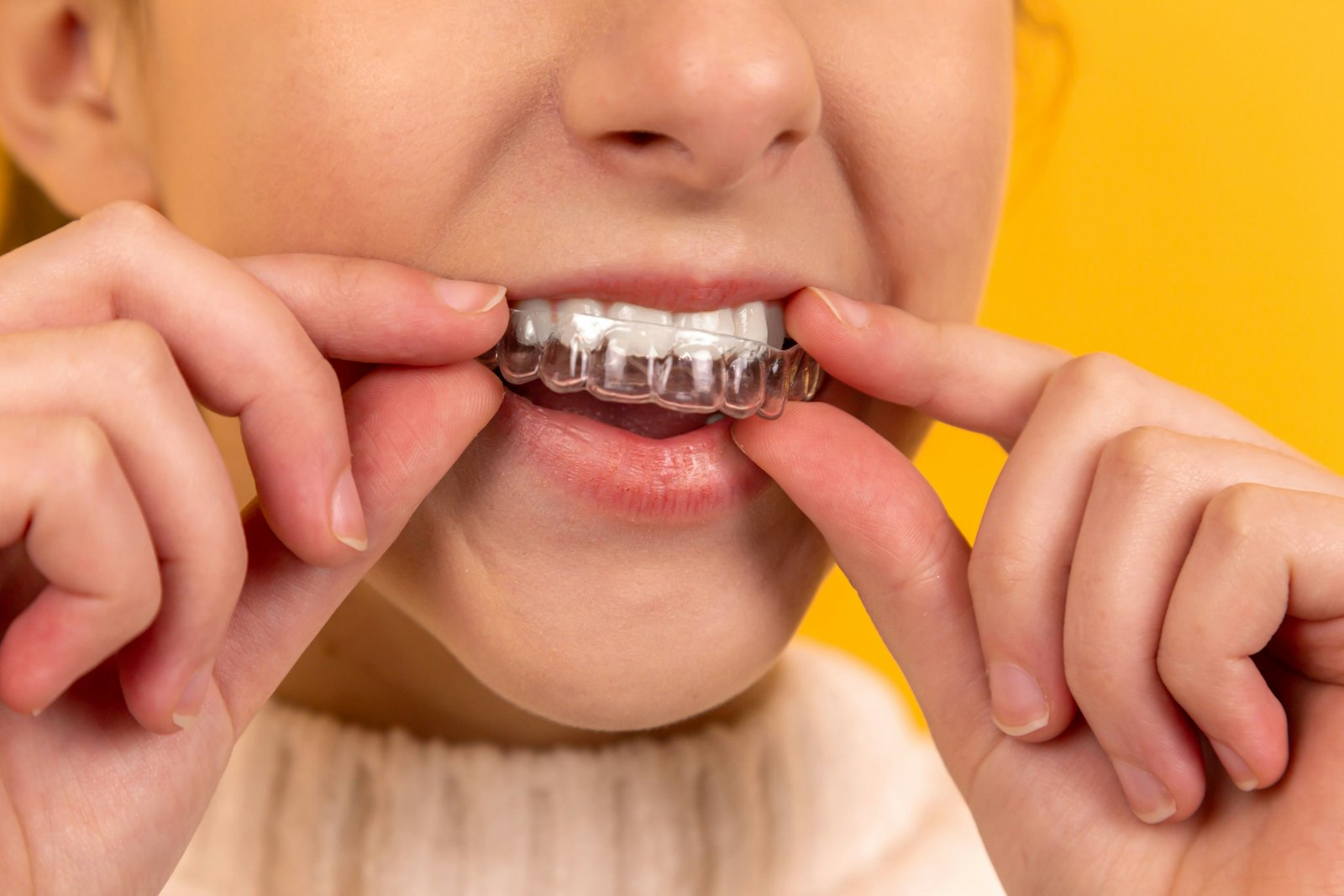
Braces, clear braces and aligners — for teens and adults.
No. Teeth move at any age, provided the gums and bone are healthy — we treat plenty of adults. Treatment can take a little longer than in teenagers, and gum health is checked carefully first.
In some form, yes. Teeth have a lifelong tendency to drift back. Most people move to wearing a retainer at night only, indefinitely. It’s a small habit that protects a long investment.
Most courses run twelve to twenty-four months, with simple cases shorter and complex bites longer. We give you a range at the planning stage and revisit it as we go — broken brackets and missed appointments are what extend it.
Fitting them doesn’t. For a few days afterwards, and after each adjustment, teeth ache and biting feels tender — soft food and simple pain relief handle it. Cheeks and lips get irritated in the first week until they toughen up, which wax fixes.
For complex cases, often yes. They can achieve movements aligners struggle with, they work continuously without relying on you, and they cost less. Aligners win on appearance and convenience. It genuinely depends on the case, not on fashion.
Your teeth drift back — reliably, and often within months. Retention is not optional, and the usual long-term routine is a retainer at night indefinitely. It’s a small habit that protects one or two years of work.
Considerably, yes — the brackets blend with tooth colour and from conversational distance they’re easy to miss. They’re not invisible: you’ll see them up close, and the wire is still there.
The ceramic itself doesn’t. The elastic ties holding the wire do, especially with coffee, tea, red wine, curry and smoking. They’re replaced at each adjustment, so any staining is temporary — but it’s worth knowing before you choose them.
No, the discomfort is comparable — a few days of aching after fitting and each adjustment. Ceramic brackets are slightly bulkier, so cheek irritation early on can be marginally more noticeable. Wax solves it.
Most cases run twelve to twenty-four months depending on complexity. Broken brackets and missed adjustments are what stretch that out, and both are largely within your control.
Simple cases can finish in around six months; more involved cases run twelve to eighteen months or longer. Your digital plan gives an estimate at the start, and wear time is the main variable that changes it.
For crowding, spacing and mild to moderate corrections, yes. For complex rotations, large movements and significant bite changes, fixed braces remain more predictable. We’ll tell you honestly which category your case falls into rather than sell you the appliance you asked for.
No — take them out for everything except water. Chewing with trays in damages them, and eating or drinking anything sugary with them in traps sugar against your enamel for hours.
Ring us. Depending on where you are in the sequence we’ll have you go back to the previous tray or forward to the next, and order a replacement. Don’t simply leave them out — teeth start moving back within days.
We provide clear aligner treatment. [VERIFY] whether the practice is a current Invisalign provider and licensed to use the brand name — until that’s confirmed we describe the treatment generically.
Pain, accidents and what to do after hours.
Usually the same day. Call 02 4933 4667 as early as you can and we’ll fit you into the emergency time we keep aside each day. Walk-ins are welcome too, though calling ahead means less waiting.
Our first job is to make you comfortable — local anaesthetic before anything sensitive, an explanation before every step, and we go at your pace. Most people tell us the anticipation was worse than the visit.
The visit starts with an examination and usually an X-ray so we can find the cause, and we quote any treatment before it starts. Health funds are claimable on the spot with HICAPS, and payment plans are available — see our fees and payment plans page.
Call 02 4933 4667 and follow the recorded guidance, then book the first available appointment online. If you have facial swelling affecting breathing or swallowing, uncontrolled bleeding or a suspected broken jaw, call 000 or go to the nearest emergency department.
This information is general in nature and is not a substitute for personalised advice from a registered dental practitioner. Any dental or surgical procedure carries risks. Individual results vary. Before proceeding with treatment we encourage you to ask questions and, if you wish, seek a second opinion from a qualified health practitioner.